How to Pay Off Credit Card Debt: Complete Strategy Guide
A proven, math-driven strategy to crush credit card debt. See why minimum payments trap you for decades, the exact avalanche vs snowball math, and how balance transfers and consolidation loans really affect your payoff.
Updated: August 9, 2026
Credit card debt is the silent wealth-killer of modern life. With average APRs above 22% in 2026, carrying a balance means paying more in interest than you originally borrowed — and the math gets worse the longer you wait.
The good news: there’s a proven, mathematically sound way out. This guide walks through it step by step, with real numbers showing exactly how small changes save thousands. Every figure here is reproducible with our credit card payoff calculator and standard amortization math.
The Trap: Why Minimum Payments Are Designed to Keep You in Debt
Let’s start with the brutal truth. If you owe $5,000 on a credit card at 22% APR and make only the minimum payment (typically 2% of balance or $25, whichever is higher):
- Time to pay off: 30+ years
- Total interest paid: $8,184 (more than 1.6× what you borrowed)
- You’ll still be paying for a $5,000 purchase in your 50s
The banks designed minimum payments this way intentionally. They want you in debt forever — every extra month you carry a balance is pure profit for them at your expense.
The math behind the trap
Here’s how dramatically the picture changes with different monthly payments on the same $5,000 balance at 22% APR:
| Monthly payment | Months to debt-free | Total interest paid | Total cost |
|---|---|---|---|
| $100 (minimum) | 109 months (9+ years) | $5,855 | $10,855 |
| $150 | 50 months (4+ years) | $2,460 | $7,460 |
| $200 | 33 months (2.75 years) | $1,488 | $6,488 |
| $250 | 24 months (2 years) | $1,077 | $6,077 |
| $300 | 19 months (1.5 years) | $836 | $5,836 |
| $500 | 11 months | $463 | $5,463 |
Bumping your payment from $100 to $200/month cuts the timeline from 9 years to under 3 years and saves $4,367 in interest. That’s not a typo — doubling your payment saves you four thousand dollars and six years of your life.
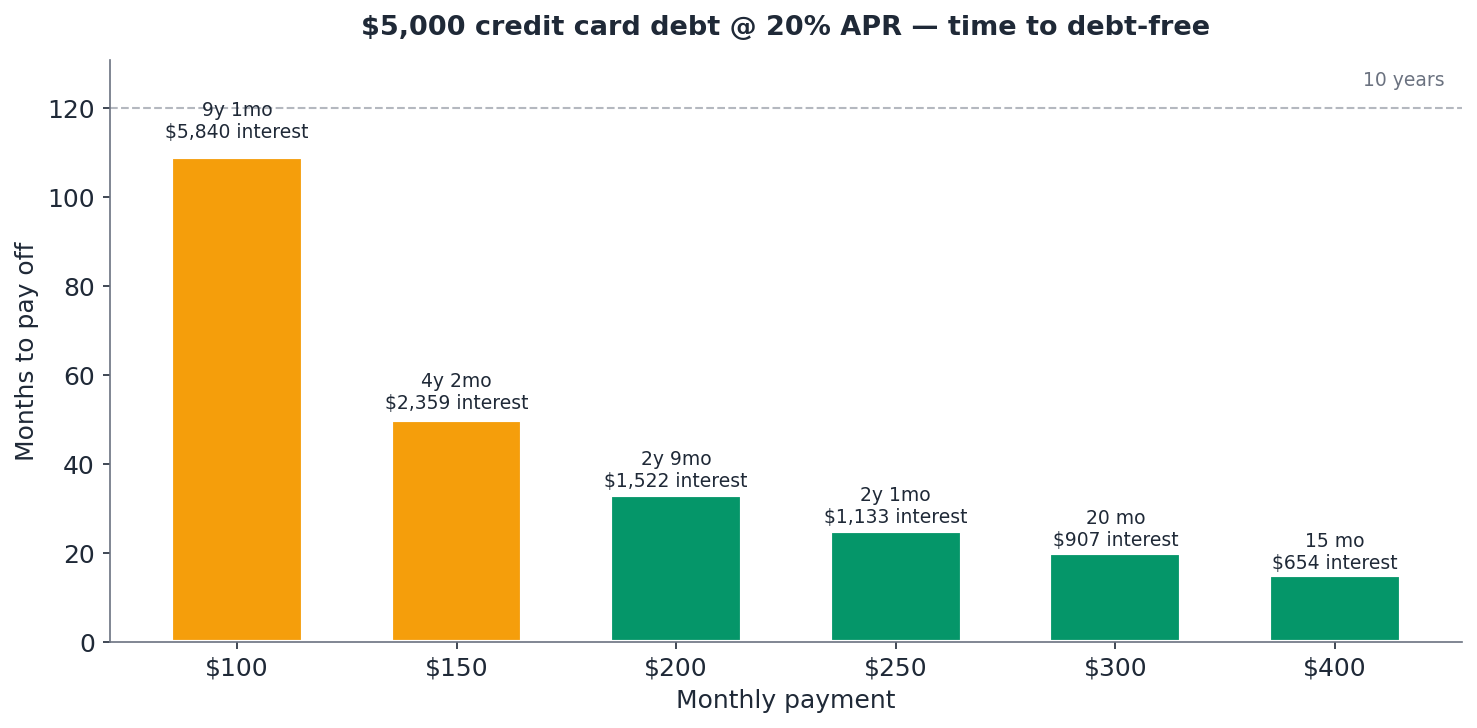
The pattern is unmistakable: every extra dollar above the minimum does double duty, because it both reduces principal and shortens the timeline on which future interest accrues.
Step 1: Stop the Bleeding
Before paying off debt, you must stop accumulating more. This step sounds obvious but is where most people fail.
- Cut up or freeze your cards (literally — put them in a block of ice so you have to wait for them to thaw)
- Switch to debit or cash for 90 days. Studies show people spend 12%–18% less when paying with cash versus plastic.
- Identify your spending triggers — stress shopping, social pressure, boredom, “treat yourself” rationalizations
- Create a bare-bones budget until the debt is gone. This means: housing, food, transportation, minimum debt payments, and nothing else.
- Unlink cards from apps — Amazon, food delivery, streaming services. Force yourself to re-enter the number each time.
This step is non-negotiable. You can’t drain a bathtub with the faucet running.
Step 2: Know Your Exact Numbers
List every credit card debt you have. You can’t attack what you can’t see.
| Card | Balance | APR | Minimum payment | Monthly interest |
|---|---|---|---|---|
| Card A | $3,200 | 24.99% | $64 | $66.64 |
| Card B | $1,800 | 19.99% | $36 | $30.00 |
| Card C | $4,500 | 22.99% | $90 | $86.25 |
| Total | $9,500 | ~23% avg | $190 | $182.89/mo |
That last column is crucial: $182.89/month is what you’re paying just to stand still. If your total monthly payment equals your total monthly interest, your balance never drops. Every dollar above $182.89 actually reduces what you owe.
You’ll use this list in Step 4 to choose your attack strategy.
Step 3: Build a Tiny Emergency Fund First
This sounds counterintuitive but is critical: before aggressively paying down debt, save $1,000–$2,000 as a starter emergency fund.
Why? Because without it, the next car repair ($800), medical bill ($1,200), or home repair ($600) goes straight back on the credit card — undoing months of payoff progress and crushing your motivation.
A small cash buffer breaks the debt cycle. Yes, you’ll pay a bit more in interest on the cards while building this fund, but the psychological and practical protection is worth far more than the ~$20/month in extra interest.
Target: $1,000 if single, $2,000 if you have dependents. Keep it in a separate high-yield savings account earning 4%–5%, not in checking where you’ll spend it.
Step 4: Choose Your Payoff Method
You have two proven strategies. Both work; the best one is the one you’ll actually finish.
The Avalanche Method (Math-Optimal)
Put all extra money toward the highest-APR card first, while paying minimums on the rest.
Using the example above (Cards A: 24.99%, B: 19.99%, C: 22.99%):
- Pay minimums on Cards B and C
- Throw every extra dollar at Card A (24.99%)
- When Card A is gone, attack Card C (22.99%)
- Finish with Card B (19.99%)
Pros: Saves the most interest. Mathematically optimal. Cons: If your highest-APR card is also your biggest balance, it takes months to see a “win,” which can kill motivation.
The Snowball Method (Psychology-Optimal)
Pay off cards in order of smallest balance first, regardless of APR.
- Attack Card B ($1,800) — gone in months
- Then Card A ($3,200)
- Finally Card C ($4,500)
Pros: Quick wins build momentum. A landmark Northwestern study found people using snowball were 14% more likely to finish than those using avalanche. Cons: Costs more in interest than avalanche.
The exact cost difference
On the $9,500 example above, assuming you can put $400/month total toward debt:
| Method | Months to debt-free | Total interest paid |
|---|---|---|
| Avalanche (highest APR first) | 30 months | $2,480 |
| Snowball (smallest balance first) | 31 months | $2,710 |
The avalanche saves $230 and one month. That’s a real difference, but not huge — and if snowball’s psychological wins keep you on track when you’d otherwise quit, snowball wins in the real world.
The verdict: If you’re highly disciplined, use avalanche. If you’ve tried and failed before, use snowball. The best method is the one you’ll actually finish. Half-finished avalanche beats abandoned snowball every time.
Step 5: Find Extra Money to Throw at Debt
This is where most people get stuck. “I have no extra money to pay toward debt.” Here’s where to find it — ranked by ROI:
1. Negotiate your card’s APR (free, 15 minutes)
Call the number on the back of your card and say:
“I’ve been a customer for [X] years and I’d like to keep my business with you, but my APR of [Y%] is making it hard to pay down my balance. Can you lower it?”
Banks lower APRs for ~30%–50% of customers who ask, especially those with on-time payment history. A 22% → 17% reduction on a $5,000 balance saves $25/month in interest — $300/year for a 15-minute phone call.
2. Balance transfer to a 0% intro APR card
Many cards offer 0% APR for 12–21 months on balance transfers (typically for a 3%–5% transfer fee). This pauses interest entirely, so 100% of your payment goes to principal.
Math: transferring $5,000 to a 0% card with a 3% fee costs $150 upfront but saves $900+ in interest over 18 months. Net savings: $750+.
Caveats:
- You need decent credit (typically 670+) to qualify
- The 0% rate applies only to the transferred balance — new purchases may still accrue interest
- After the intro period, the rate jumps to 22%+; pay it off before then
- Don’t use the freed-up credit limit — that’s how people end up with more debt than they started
3. Personal loan consolidation
If your credit is decent (680+), you might qualify for an unsecured personal loan at 8%–12% APR to pay off credit cards at 22%+. On $10,000 of debt, dropping from 22% to 10% saves $100/month in interest — $1,200/year.
Pros: Lower rate, fixed payoff date, one payment instead of many. Cons: Requires good credit; origination fees (1%–6%); doesn’t fix the spending behavior that caused the debt.
4. Side income
Even $200/month from a side gig — driving, tutoring, freelancing, selling items — applied directly to debt turns a 9-year payoff into a 2-year payoff on a $5,000 balance.
5. Cut expenses temporarily
$100/month in cuts (subscriptions, eating out, gym) = $1,200/year of debt payoff. This isn’t forever — just until the debt is gone.
Step 6: Automate and Let Math Do the Work
Set up automatic payments above the minimum, timed to your payday. Then let time and math do their work.
The key insight: once you’ve set the payment amount and automated it, stop thinking about the debt day-to-day. Check in monthly. Make your snowball/avalanche adjustment when a card hits zero. Otherwise, let the system run.
Use our credit card payoff calculator to:
- Find your exact debt-free date at any payment level
- See how much faster you’ll be debt-free with $50, $100, or $200 extra per month
- Set a target payoff date and learn the payment needed to hit it
- Compare avalanche vs snowball with your real balances
Realistic Timelines by Debt Size
| Debt amount | Aggressive ($400+/mo) | Moderate ($200–$300/mo) | Minimum only |
|---|---|---|---|
| $2,000 | 5–6 months | 10–12 months | 10+ years |
| $5,000 | 14–18 months | 2–3 years | 30+ years |
| $10,000 | 2.5–3 years | 4–5 years | 40+ years |
| $20,000 | 5–6 years | 9–10 years | Never (interest > payment) |
Assumes 22% average APR. “Never” means the minimum payment doesn’t cover monthly interest.
The faster you pay it off, the more money you redirect from interest to your future. Every month you accelerate is money in your pocket, not the bank’s.
Warning Signs You Need a Different Approach
Some situations need more than DIY payoff strategies:
- Your total minimum payments exceed 30% of your take-home pay → consider credit counseling (NFCC.org, legitimate non-profits)
- You’re being sued by a creditor → talk to a bankruptcy attorney; Chapter 7 may be appropriate
- You’ve tried payoff plans 3+ times and always relapse → the spending behavior needs addressing first, possibly with professional help
- Your debt is medical, not credit card → medical debt has different rules and often negotiable; never put it on a credit card
Legitimate help costs little or nothing. Avoid any “debt relief” company that charges upfront fees — they’re almost always scams.
After You’re Debt-Free
Once the cards are paid off, don’t close the accounts (closing them hurts your credit utilization ratio and average account age). Instead:
- Pay your statement balance in full every month — never carry a balance again. Set up autopay for the full statement balance.
- Redirect your debt-payment amount to savings/investing — you’re already used to living without that $400/month; funnel it to a savings goal or retirement instead.
- Build a 3–6 month emergency fund so future surprises (job loss, medical, car) don’t send you back into debt.
- Keep one card for regular use — pay it in full, build credit, earn rewards. The card is now a tool, not a trap.
This is how compound interest stops working against you and starts working for you. The $400/month that used to pay 22% interest to the bank now earns 7%–10% in investments — a swing of $850+/month in your net worth trajectory.
The Bottom Line
Credit card debt feels permanent, but it isn’t. The math is brutal but clear:
- Stop accumulating new debt (non-negotiable)
- Build a $1,000 emergency fund first
- Pick avalanche or snowball and commit
- Find extra money via APR negotiation, balance transfers, or side income
- Automate the payment and let math do its work
Within 2–5 years, you can be completely debt-free — and the money that used to fund bank profits starts funding your future.
The hardest part is starting. Run your numbers today with our credit card payoff calculator — seeing your debt-free date on screen is the motivation you need to begin. The second-best time to start was yesterday; the best time is now.
Try it yourself
Numbers are better when they're your numbers. Run your own numbers with our free calculator.
Open Calculator